
NIFTY & INDIAN EQUITY MARKET OUTLOOK – AUGUST & SEPTEMBER 2025
By Rahul Vashistha | 10 August 2025
—
Recap & Context
In my previous market outlook, I highlighted the possibility of short-term volatility in the Indian equity markets, driven primarily by the US tariff issue. I also mentioned that we could see a near term & short lived correction & markets could face hiccups due to tariff situation, before the broader uptrend resumes. Over the past month, that prediction has played out almost exactly as anticipated.
With that backdrop, let us now assess where we stand in terms of valuations, macro growth outlook, sector performance, and the likely trajectory for the coming months.
—
1. Macro & Policy Drivers
US Tariffs
In FY25, India exported goods worth US$87 billion to the United States, which accounted for 20% of India’s total exports and around 2% of the US’s total imports. The sectors likely to be most affected by the new US tariffs include auto components, gems and jewellery, machinery, and textiles.
On the other hand, certain industries — such as pharmaceuticals, electronics manufacturing services (EMS), and parts of the specialty chemicals space — have been exempt from the tariff hikes. Given the historical precedent and the negotiating style of President Trump, there is a reasonable probability that a trade settlement will be reached over time.
From a macro perspective, India’s GDP growth for FY26 is currently projected at 6.5%. The tariffs could have a short-term negative impact of around 0.2% of GDP, but such effects tend to be quickly priced in by the markets and adjusted for over the medium term.
—
Pharma Tariff Scenario – Minimal Risk for India
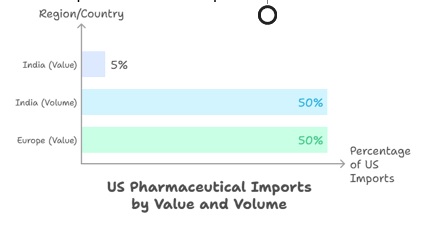
To put the numbers in perspective, the United States imports pharmaceutical products worth approximately US$215 billion annually. Of this, India contributes around US$10–11 billion, which represents just 5% of the US pharma import market by value.
However, the real strength of India’s pharmaceutical industry lies in the generic drug segment, where it dominates in volume terms. India supplies roughly 50% of the generic drugs consumed in the US by volume, but because these are low-value products, they contribute only 5% in value terms.
In contrast, the bulk of US drug imports by value — about 50% — come from just five European countries: Ireland, Germany, Switzerland, the Netherlands, and Italy. These are primarily high-value, patented medicines from companies such as Eli Lilly and Novo Nordisk.
Because India primarily operates at the “bottom of the pyramid” in terms of product pricing, its pharma exports are far less vulnerable to tariff pressures. The greater risk lies with European Innovators, whose high-value exports are more exposed.
—
2.Inflation & RBI Policy Stance
Consumer Price Index (CPI) inflation for June came in at 2.1%, down from 2.8% in May and below consensus expectations. The easing was driven largely by continued softening in food prices.
Given current trends, CPI inflation for FY26 is expected to average around 2.8%, which is 90 basis points lower than the Reserve Bank of India’s (RBI) own projection of 3.7%.
In its recent meeting, the RBI opted to keep the repo rate unchanged at 5.5%, citing uncertainty around the global trade environment due to tariffs. However, we still expect there is room for a 25 bps rate cut later in CY25 to further support growth momentum. These conditions remain broadly supportive for the equity markets.
—
3.Domestic Flows vs. Foreign Flows
Systematic Investment Plan (SIP) inflows have averaged approximately ₹270 billion (US$3.2 billion) per month during Q1 FY26, marking historic highs and demonstrating the deep and sustained faith that domestic investors have in Indian capital markets.
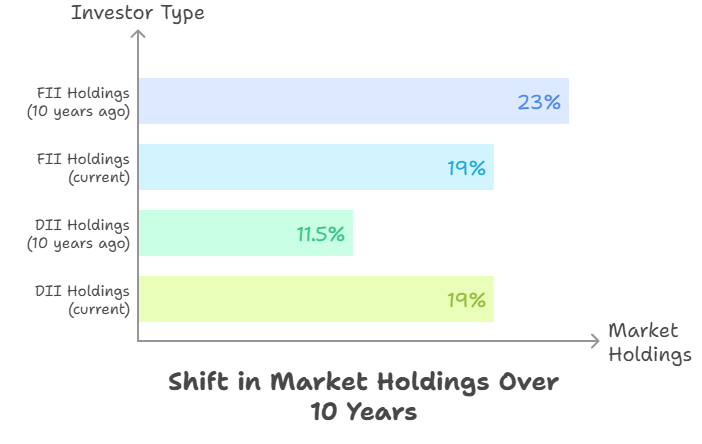
Foreign Institutional Investors (FIIs) have been net sellers in India for over a decade now, gradually ceding market share to Domestic Institutional Investors (DIIs). This trend appears to be firmly entrenched and is not a cause for concern from a long-term perspective.
Over the past 10 years, FII holdings in the Nifty 500 have fallen from 23% to 19%, while DII holdings have risen from 11.5% to nearly 19% over the same period. This shift underscores the growing depth and resilience of domestic capital, which now plays a more dominant role in supporting the markets.
—
4.SECTOR SNAPSHOTS
Financials
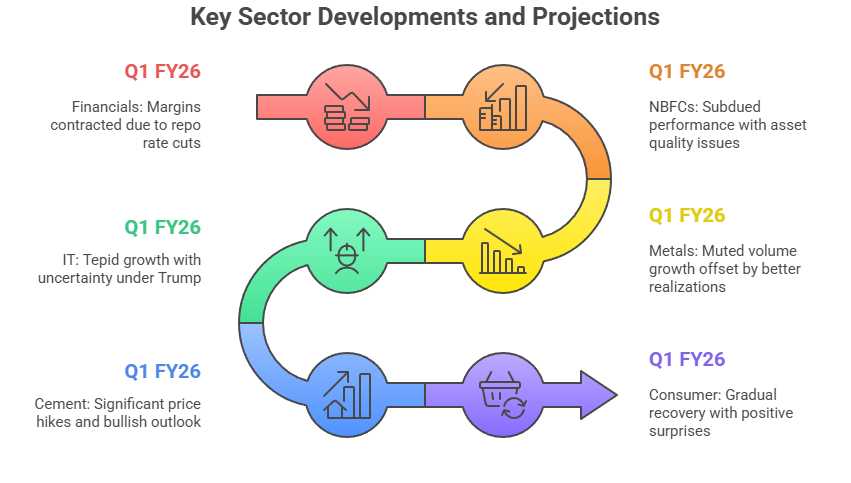
Margins for banks contracted during Q1 due to earlier repo rate cuts, and we expect them to moderate further in Q2 as the full effect of the rate reductions is passed through to borrowers. Most banks project that earnings growth will bottom out in the first half of FY26 before improving thereafter.
In the Non-Banking Financial Company (NBFC) space, performance was subdued, with asset quality under pressure and loan growth muted in Q1 FY26.
—
Metals
The metals sector delivered largely muted volume growth in Q1, but benefited from better realizations. This helped offset some of the volume weakness.
—
Information Technology
The IT sector had a tepid quarter, with median constant currency quarter-on-quarter growth coming in at less than 1%. Given ongoing uncertainty around US policy under President Trump, we do not expect any meaningful upside in the near term for this sector.
Cement – A Stronger Phase Emerging
The cement industry went through a challenging phase between FY22 and FY25. However, in the most recent quarter, companies across India implemented significant price hikes, ranging from 5% to 15% depending on the region. Southern India led the way, with Ramco Cements reporting a 14% sequential increase in realizations, and Shree Cement seeing a 4% rise.
Ultratech, in its earnings call, explicitly noted that “South is the new North,” signalling a bullish stance on the southern market.
Volume growth across the industry was mixed. Ambuja Cement stood out with a 13% organic volume increase on a consolidated basis, while Dalmia, Ramco, and Shree posted volume declines.
The combination of higher realizations and lower operating costs per tonne has resulted in a sharp improvement in EBITDA per tonne for many players. This trend is likely to continue through FY26, explaining why many cement stocks are hitting new highs despite the broader market’s subdued sentiment.
—
Consumer – Gradual but Steady Revival
As anticipated, the recovery in consumer demand has been gradual, with the most visible impact expected in H2 FY26. Q1 FY26 earnings showed moderate growth in the sector, in line with earlier expectations.
For example, Hindustan Unilever (HUL), which had been a laggard among FMCG peers for several quarters, surprised positively with 4% volume growth on a consolidated basis, compared to street expectations of 2–2.5%. This was supported by a robust management outlook indicating early signs of demand revival.
Rural growth continues to outpace urban demand, but the steady recovery in urban consumption is the key highlight. We expect institutional buying to drive further gains in consumer stocks, and it would not be surprising to see these names outperform the Nifty over the next few quarters, potentially leading the next leg of the market rally.
5. VALUATION & MARKET POSITIONING
With over 80% of Nifty companies having reported results, aggregate earnings growth stands at 7.5% YoY, largely in line with consensus estimates but skewed toward the lower end of expectations.
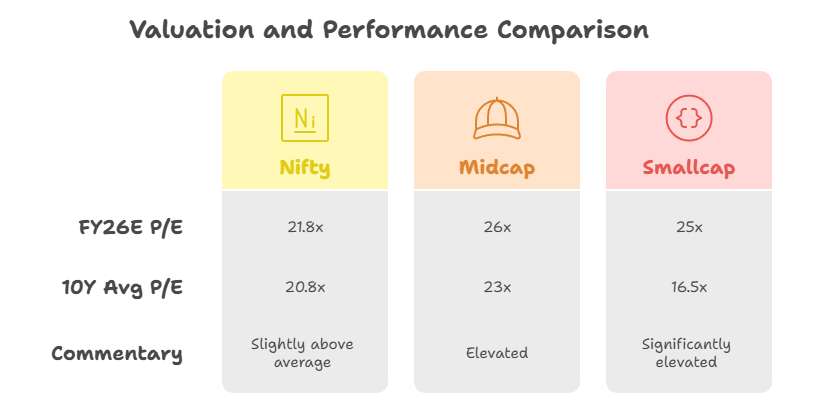
Valuation snapshot:
Index FY26E P/E 10Y Avg Commentary
Nifty 21.8x 20.8x Slightly above long-term average
Midcap 26x 23x Elevated
Smallcap 25x 16.5x Significantly elevated
The market cap-to-GDP ratio currently stands at 124%, down from 146% before the October 2024 correction.
In USD terms, Nifty returns have been modest at +2% YTD, underperforming both developed and emerging markets. Notably, South Korea has delivered over 40% returns in CY25 so far.
—
6.STRATEGY & OUTLOOK
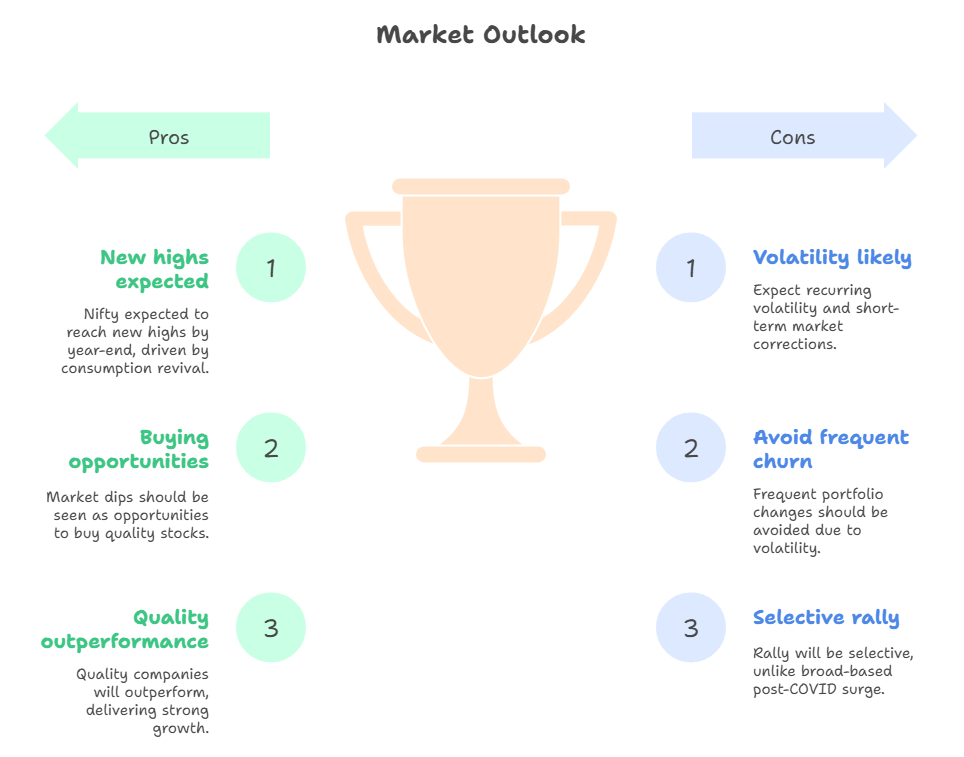
Our core stance remains unchanged: we expect the Nifty to make new highs toward the end of this calendar year, driven primarily by a revival in consumption. Any dips should be viewed as buying opportunities.
However, investors should not expect a smooth, linear uptrend. Volatility and short-term corrections are likely to be recurring themes this year, so frequent portfolio churn should be avoided. We anticipate at least one more similar correction to (July-Aug) before the index moves decisively to new highs.
This rally will be selective, with quality companies delivering strong top-line and bottom-line growth outperforming the broader market. The nature of this rally will be very different from the broad-based surge seen in the post-COVID years.
—
7.SECTORS TO AVOID FROM PREVIOUS RALLY
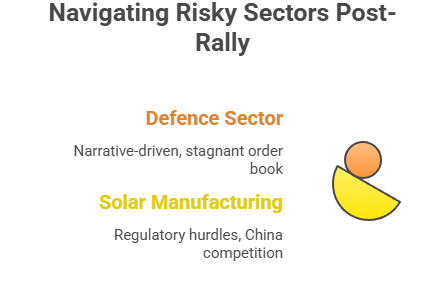
Defence: Valuations have reached unjustifiable levels, driven more by narrative than fundamentals. Order book growth has been stagnant, even in Q1 FY26. This makes the sector more of a speculative play than a long-term investment.
Solar Module Manufacturing: Facing regulatory hurdles in the US and stiff competition from China. Even strong profitability has not translated into stock price appreciation, and the sector has fallen out of favour with investors.
—
8. GROWTH POCKETS FOR FY26
Areas with strong potential include:
Automobiles: Royal Enfield (Eicher) and TVS in 2-wheelers; SUVs in passenger vehicles; tractors.
Chemicals: Specialty chemicals and agrochemicals.
Technology & Infrastructure: EMS, AI & data centres, capital markets, electricity transmission and distribution.
Industrials & Healthcare: Cement, CDMO pharma, diagnostic labs.
Consumption Plays: Value retail, Q-commerce, FMCG (especially from Q3 FY26 onwards).
—
Bottom Line
Despite global headwinds, the India growth story remains intact. The market is underpinned by strong domestic flows, healthy corporate earnings, and multiple sector-specific tailwinds. Investors should focus on patience, quality stock selection, and avoiding the temptation to chase overheated narratives.
This is a market where discipline will be rewarded — the opportunities are there, but they will accrue selectively to those positioned in the right pockets of growth.
—
Rahul Vashistha
(This article is part of my ongoing market outlook series.)